A Heron, a Ghost, and the Art of Catching Attention
Before people can care or act, they have to notice. This place-based investigation asks how imagery, storytelling, and design can make an invisible threat harder to ignore.
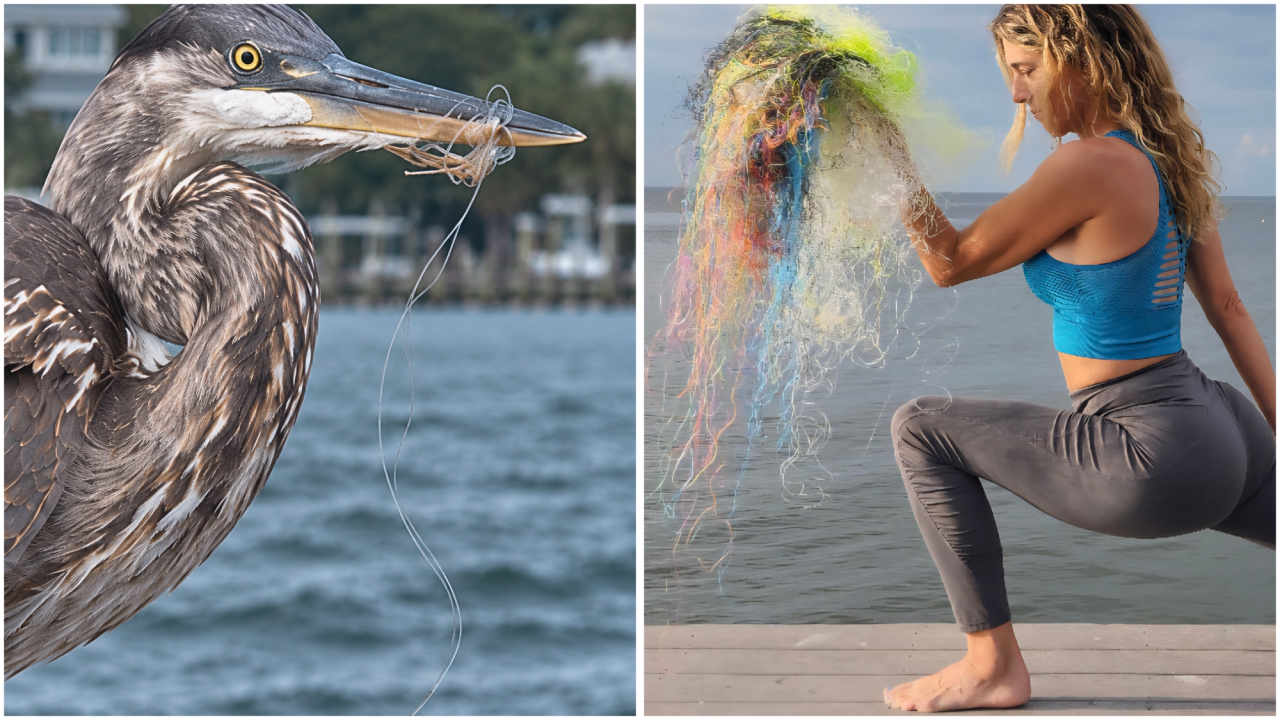
Fishing line entangles.
Could it also catch our attention?
Epic voyages don’t always begin with fanfare or a grand departure. Some don’t even begin with awareness. Mine began with a bucket, a garbage bag, and a sense something's worth showing up for.
I pulled into Veterans Memorial Park at 8:05 a.m. on Saturday. Sharon’s blue Toyota truck was parked beneath an oak tree, and a fair breeze blew off Pensacola Bay. The air was cool against my skin, but it was August in Florida, and that feeling would not last long.
The tailgate was down. A stack of cat-litter buckets sat beside a pile of yellow trash grabbers and a box of garbage bags. I found the volunteer sign-in clipboard and added my name to the list—I was the eighth volunteer to show up that morning.
Ocean Hour organizes recurring cleanup sites across Pensacola and the surrounding area, supplying the bags, buckets, and grabbers needed for volunteers to spend an hour removing debris from their beaches, parks, and waterways. “An hour to help the ocean is an hour well spent,” they say. Hard to argue with that.
I gathered my gear and set out along the path—a sauntering pirate in search of her treasure.
A Walk in the Park
I walked along the sidewalk scanning the grass for litter. Cigarette butts, napkins, and Whataburger cups were standard park fare, but today it was immaculate, almost too clean. The feeling was somewhere between civic pride and mild disappointment.
I crossed the boulevard and stepped onto the running path, the last clean line between downtown and Pensacola Bay. The view was breathtaking, but I was not there to admire scenery. I had come to collect debris—and lots of it.
Welcome to the Borderland
A dense swath of tall green grasses rose from the water’s edge and drew my gaze down to an astonishing spectacle of color. Thousands of pieces of debris lay tangled in wet grass, pressed into mulch, and floating in the shallows. This was a marshy borderland, neither fully land nor fully sea, that had served as a natural collection point for waste traveling through the surrounding area.
The borderland looks wild, but it isn’t entirely. It forms part of Project Green Shores, a constructed living shoreline created to restore salt marsh, oyster-reef, and seagrass habitat while stabilizing Pensacola’s urban bayfront.
It was here my work began. I stepped through the wet grasses toward a large pool of water, probing the mulchy ground for firm footing (and snakes) before committing my weight one step at a time—it’s not the kind of water you want to fall into.
One by one, I began collecting and dropping objects into the bucket. I started with the largest items: water bottles, a bucket lid, part of a red buoy, and an oven mitt—what was it doing there? Then came the smaller pieces: candy wrappers, aqua dental picks, two pink neon bobbers, a Nikon lens cap, receipts, and a seemingly endless supply of microplastics.
A yellow plastic dinosaur emerged from the wet grass. I washed it off and slipped it into my pocket: a child’s fossil from the age of convenience.
The Line in the Heron’s Beak
The shift that sparked a strategy happened the next day, but I never saw it coming. I showed up for the Ocean Hour cleanup at the Bob Sikes Bridge, which overlooks Santa Rosa Sound and connects the town of Gulf Breeze with the barrier island of Pensacola Beach.
That morning Jen, one of the group’s coordinators, mentioned a cache of bottles that had washed up on the rocks and suggested I explore that area. The state had issued a poor water quality advisory, cautioning against skin contact with the water due to the high concentrations of bacteria. But I was wearing my gold rubber goddess boots, a gift from my neighbor Chris, and was eager to put them to good use.
I worked my way down the rocks, slippery with moss and mud, collecting bottles at a steady clip. About 30 feet away, a great blue heron stood in the water with statuesque stillness, the epitome of grace and elegance.
As I drew closer, the heron remained still. It seemed frightened and stared straight at me, but it didn’t flee. The morning light shifted and revealed a cluster of translucent fishing line trailing from the heron’s beak. The line appeared to be caught in its throat, and this beautiful bird was clearly suffering.
I had seen fishing line tangled on rocks and caked together with moss and mulch like the clump one volunteer found that morning, but until then had never seen the impact firsthand. This lone injured heron gave the problem a face and lent the encounter a haunting sense of humanity.
This was a living creature, after all, and that made the problem feel intimate and personal. It turns out the line in the heron’s beak had a name, and so did the larger problem: ghost gear and ghost fishing. I had never heard those words before, but I was eager to learn more.
Ghost Fishing and the Afterlife of Gear
Ghost gear is fishing equipment that has been lost, abandoned, or otherwise discarded: nets, line, rope, traps, pots, and floats. Ghost fishing describes what happens when that gear continues to perform its job long after it has left human control—catching, trapping, and entangling animals.
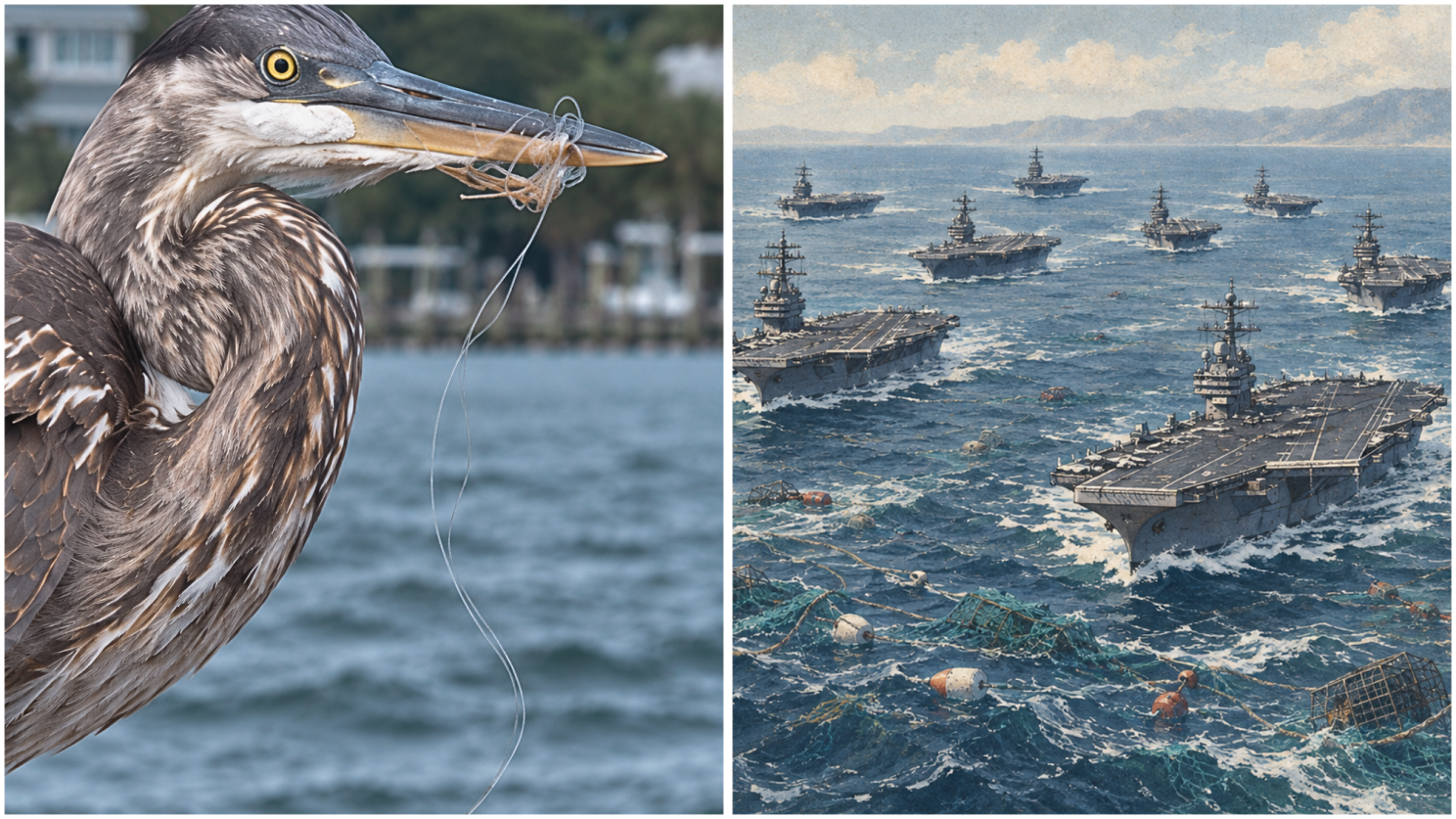
At the high end, estimated annual ghost-gear losses weigh as much as eight Nimitz-class aircraft carriers—nearly the entire 10-ship U.S. fleet.
How does fishing gear become ghost gear? This story has no single villain or simple cure. Gear can be lost during storms, when heavy catches overload equipment, or when poorly maintained gear breaks. It may be abandoned because retrieval is dangerous or prohibitively expensive, or discarded where disposal and recycling facilities are unavailable. Conflicts between fisheries and destructive fishing practices also contribute to the problem.
But fishing communities depend on healthy waters, and many fishermen participate in prevention, reporting, recovery, and management efforts. Once gear breaks free, however, it can move through an ecosystem for years, continuing to entangle and trap fish, turtles, seabirds, marine mammals, and other wildlife.
The global numbers are difficult to measure precisely, and estimates vary by geography and method, but one widely cited estimate places annual ghost-gear losses at approximately 600,000 to 800,000 metric tones.
At the high end, that is roughly the weight of eight Nimitz-class aircraft carriers —nearly the United States’ entire 10-ship Nimitz-class fleet—entering the ocean each year as nets, rope, line, traps, and floats.
Wading among the rocks, I did not need statistics like this to appreciate the danger or the individual cost. That was visible in the fishing line that streamed from the heron’s beak.
Catching Our Attention
Until then, ghost fishing had remained fairly abstract to me, but the sight of the heron made it visible and personal. Powerful images can reveal issues, relationships, and truths we have avoided or simply missed and unlock empathy. The heron did not offer a 10 tip carousel to prevent ghost fishing or deliver a webinar about responsible recreation. It simply stood in silence and commanded the surrounding space long enough for the impact to land inside me with a thud.
Effective environmental communication does not need to explain all sides of an issue or present a global vision to catch our attention. Sometimes a narrower frame is more powerful: a provocative yet restrained image, a poignant question, simply posed, or a glimpse into a truth that is easily overlooked. The contrasts create their own pull. They interrupt the everyday rhythm long enough for us to stop and register what we are seeing.
But capturing attention and raising awareness are only the beginning of change. What matters next is the action that follows.
I knew I would continue picking up litter with Ocean Hour, but the encounter also made me ask what else I could do—and where my background might make a meaningful difference. Everyone brings different skills; mine are rooted in art, design, communication, systems, and a stubborn habit of looking closely at issues.
I wanted to understand the kind of programs that were addressing ghost fishing locally and initiatives focused on preventing fishing lines from reaching the water in the first place. I was eager to learn about what had already been built, what was working, and where gaps might be, that I could potentially help fill and build upon.
That search for existing programs quickly led me to Florida’s Monofilament Recovery and Recycling Program. Overseen by the Florida Fish and Wildlife Conservation Commission and supported by local partners and volunteers, the program has established a statewide network of collection points for recovering and recycling used fishing line. On paper, it seemed like the perfect place to start.
A Site Survey Close to Home
II made a simple plan. I selected 15 monofilament collection sites shown on the program’s map across Pensacola, Warrington, and Gulf Breeze and set out to visit them one by one, ask questions, and document what I found. With respect for what had already been built, I wanted to understand what seemed to be working well, and consider how communication design and today’s technology might help it work better.
At each site, I asked what a person actually sees, understands, and feels invited—and able—to do. Could I find the collection point? Was its purpose apparent? Did it make both the action and its consequences clear? Was it being maintained? Could someone easily report a missing or damaged bin? Could I, as a citizen, see the program’s current status or collective impact? What did the people nearby know about it?
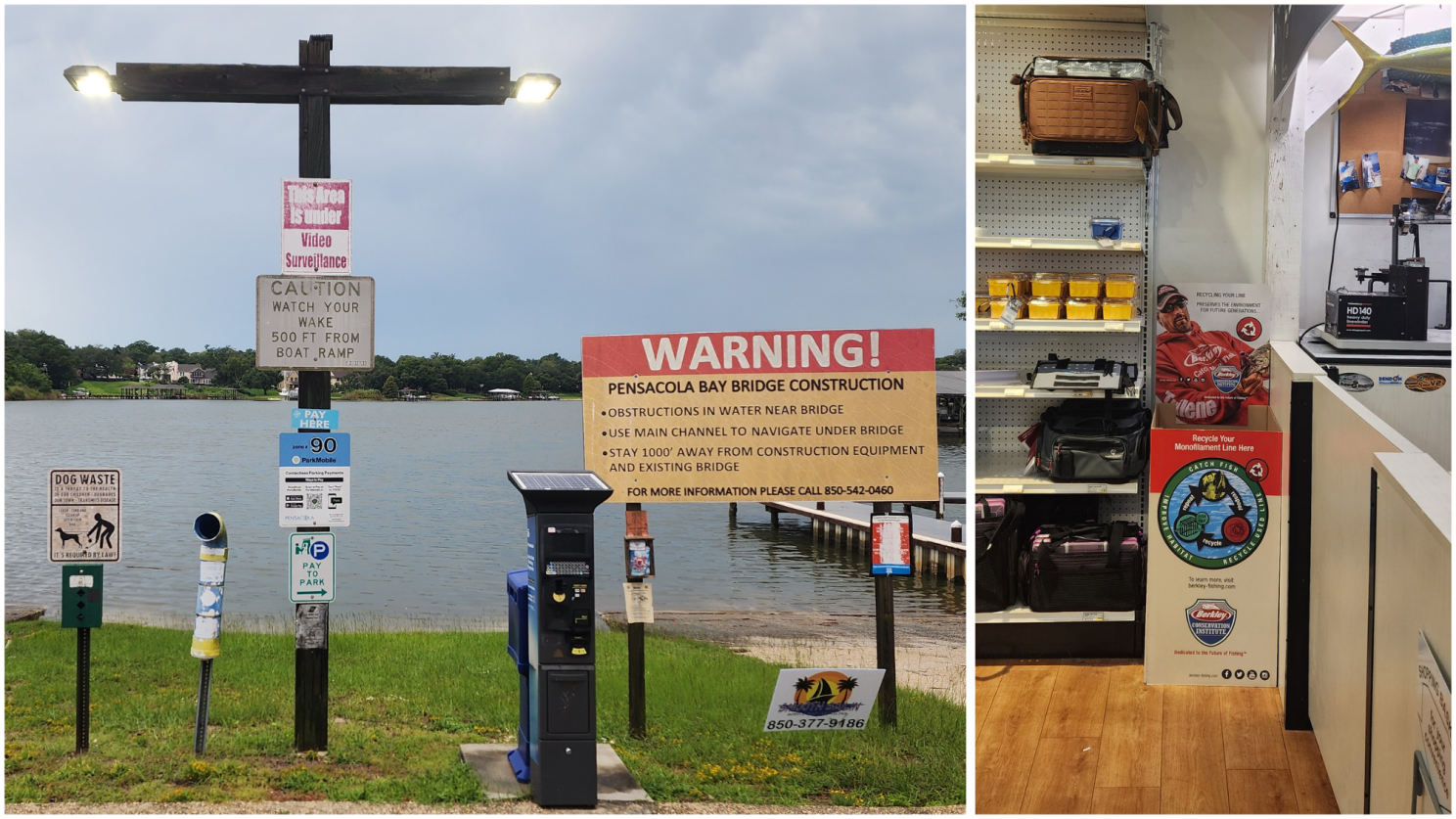
Monofilament collection points in Pensacola reveal a range of effectiveness: an aging bin at Bayou Texar Boat Ramp and a staff-managed West Marine collection point for customer drop-offs and line removed when fishing reels are respooled. August 2026.
I have now visited 14 of the 15 sites and am organizing the information so the patterns can be examined and shared. Of the 14 sites, I was unable to locate 9 collection points, but the state of the 5 sites I did find ranged from neglected or difficult to recognize to visible, well maintained, and clearly cared for.
The first site I visited was on Bayou Texar, only a quarter mile from my house. A weathered collection tube stood beside a thicket of official-looking signs broadcasting video surveillance, caution, pay to park, dog waste disposal, and a bold warning about the bridge. Nearly every visible message told visitors what not to do, what to avoid, or what rule to follow.
The collection point was intended as an invitation, but its faded decals were almost impossible to read and the cumulative effect felt more like a place to avoid than an opportunity to participate.
Other sites told a more encouraging story. The collection point at the Pensacola Beach Fishing Pier was prominently displayed with bilingual decals and appeared well maintained. At West Marine I found an indoor collection box where employees deposited line removed during reel respooling, then sent the accumulated material to the Berkley Conservation Institute for recycling. The indoor setting made West Marine an outlier, but the contrast was instructive. The collection box had a clear purpose and sponsor, was positioned where fishing line was already being handled, and was supported by employees who knew what happened next. It was not simply a container. It was part of a functioning process with visible ownership.
A Longstanding Program with Even Greater Potential
Conversations with fishermen, business owners, and residents near abandoned collection points were equally eye opening. Everyone saw the need and wanted to see more done. Some offered ideas on improvements to make while others volunteered to help with a collection point at that site. I was struck by how open people were and the sensitivity they showed.
The survey has deepened my respect for Florida’s Monofilament Recovery and Recycling Program and strengthened my belief in its potential to have an even greater impact.
Developed more than two decades ago, the program was built in a different technological era. Today, widely available tools—QR-linked site records, mobile reporting forms, maintenance reminders, and public-facing dashboards—could make the network easier to monitor, maintain, and join. Stronger visual communication could also help each collection point do more than receive discarded line. It could explain why the action matters, reveal the larger collective effort, and invite people to participate. A more recognizable visual identity could improve awareness, while a broader communications strategy could extend the program’s reach and increase participation.
A local pilot could test these possibilities at a manageable scale, collect evidence about what works, and use those lessons to strengthen the program’s existing foundation. The survey is not yet complete, but it has already begun to point to possible path forward.
Making the Invisible Harder to Ignore
By then, I had spent days untangling the practical threads surrounding the problem—locations, ownership, maintenance, reporting, and public participation. But analysis was only one way of understanding it. To imagine how communication might move people, I needed to step away from the mechanics of the system and return to the material itself—to beauty, feeling, and the creative impulse to make something visible.
Before I left West Marine, I took some of the collected monofilament with me. I stuffed it into my backpack and brought it to a pier where I like to welcome the day by watching local fishermen cast their nets.
The open horizon offered a kind of reset—an expanse that felt energized rather than vacant. It brought to mind Japanese designer Kenya Hara, who writes in White of emptiness not as nothingness but as a receptive state charged with possibility. Looking across the water, I felt that possibility in the open space before me. It seemed alive with what might enter it—attention, imagination, and a future not yet formed.
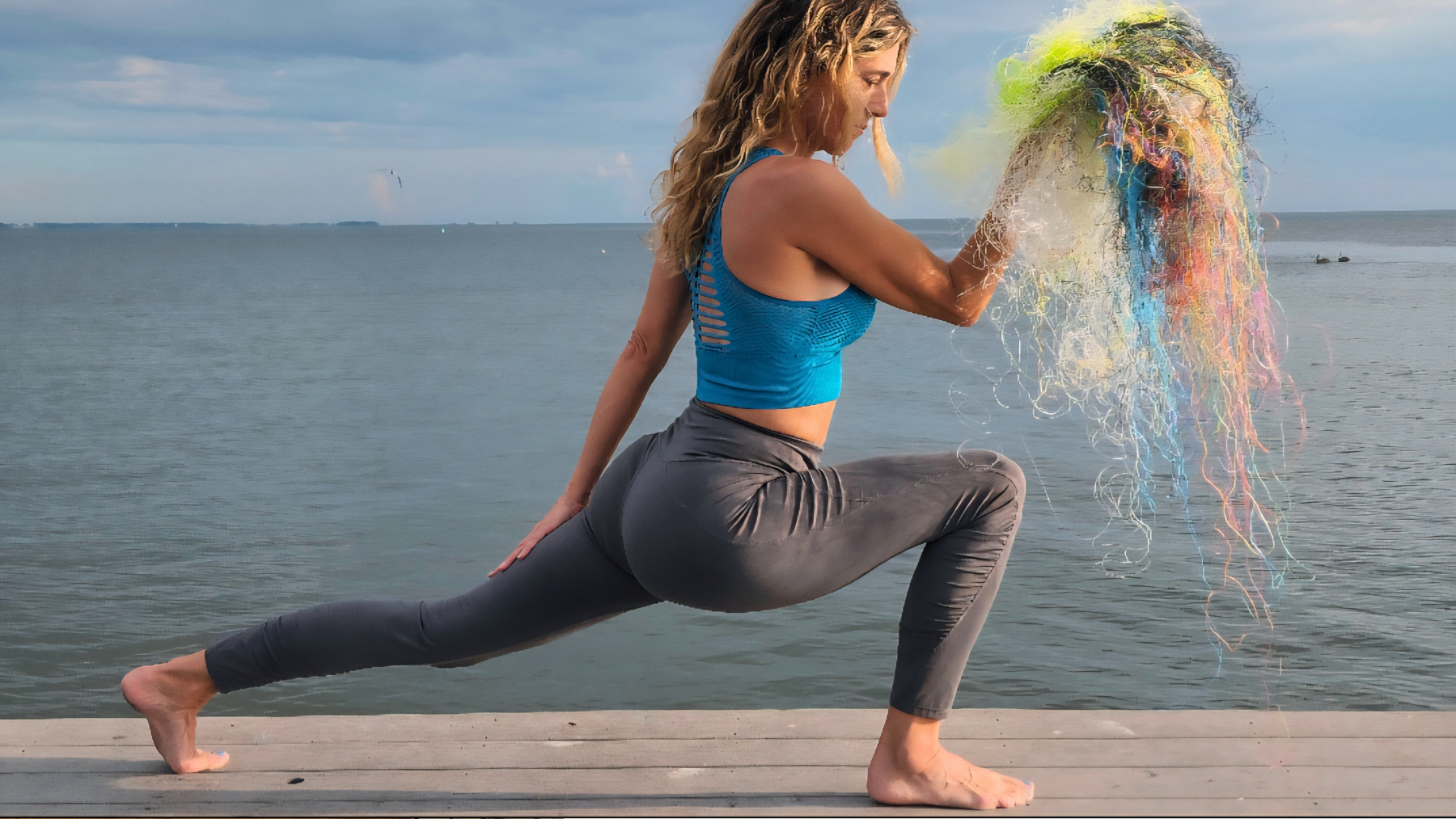
Against the open horizon, recovered monofilament becomes visible, and difficult to ignore, revealing the physical presence of a threat that often disappears against the water. Sanders Beach, Pensacola, Florida. September 2026.
Held against that expanse of water and sky, the monofilament felt electric and luminous. What had been almost invisible on the ground suddenly took on presence. Its loose, tangled energy suggested a visual language of its own, grounded in beauty, movement, stillness, fragility, reflection, care, and connection.
Beauty did not make the line harmless or erase what it had done. But it changed how I could see it. The material became more than discarded waste or evidence of a damaged system; it became a way of making the problem felt.
Ghost fishing cannot be solved by imagery alone. It requires clear ownership, maintained infrastructure, useful data, and sustained participation. But those systems also need communication that reaches people emotionally, makes consequences visible, and helps them imagine their own place in the response.
Standing at the edge of the pier, I began to see material and meaning come together: the fishing line that had caught the heron might also catch our attention—and hold it long enough for care to become action.