Pensacola Area Monofilament Recycling Site Assessment
An independent, in-person assessment of 15 listed recycling locations—and an opportunity to strengthen a valuable Florida conservation network.
Overview
Discarded fishing line and gear are a familiar presence along Pensacola-area waterfronts and an everyday reminder of the need for education, local action, and effective systems for preventing marine debris and removing it from our waters.
As a local resident, conservation-minded communicator, and designer interested in how systems build empathy and shape behavior, I wanted to learn more about a widely referenced Florida program that addresses this need and understand how the state’s investment in monofilament recycling is functioning in my community.
This independent, in-person assessment reviewed 15 monofilament recycling bins identified across the greater Pensacola area, which is part of a lager state-wide network of approximately 1600 bins. It asked a practical question: when someone is near one of these locations and receptive to recycling, does the local station make that action easy to find, understandable, credible, and meaningful?
Florida’s Monofilament Recovery and Recycling Program provides an important foundation for reducing fishing-line pollution through public education, collection infrastructure, stewardship, and recycling. The assessment found that this foundation remains valuable, but the program would benefit from renewed attention to bin design, communication, maintenance, local participation, and stewardship.
Approach
The survey was not intended as an exhaustive audit of the statewide program, nor does it measure recycling volume, the work of individual sponsors, or environmental outcomes. It is a localized snapshot of the public experience: whether bins could be found at listed locations, whether mapped information aligned with site conditions, and whether each bin’s condition and communication encouraged participation and earned public trust.
Each location was visited in person and assessed for:
Bin availability and findability
Listing and map accuracy
Decal legibility and clarity of instructions
Bin condition and contents
Visible stewardship or sponsor information
Compelling, empathy-building educational content
A low-friction pathway for individuals to take action
An Incomplete Local System
A key finding of the survey is that the local network is incomplete. Of the 15 listed locations surveyed in the Pensacola, Florida area, only 5 bins could be located following a 30 minute search at each site. It wasn’t clear why the missing bins had been removed or if the removal was permanent.
The survey also identified discrepancies in the supporting location data. At one site, the listed downtown Pensacola address did not correspond to the mapped pin. At another, the Pensacola Beach location had an address discrepancy even though the bin itself was present and in good condition. A recycling station is only as effective as its ability to be found, trusted, and used when people are ready to participate.
A Range of Results: From Stewardship to Noticeable Neglect
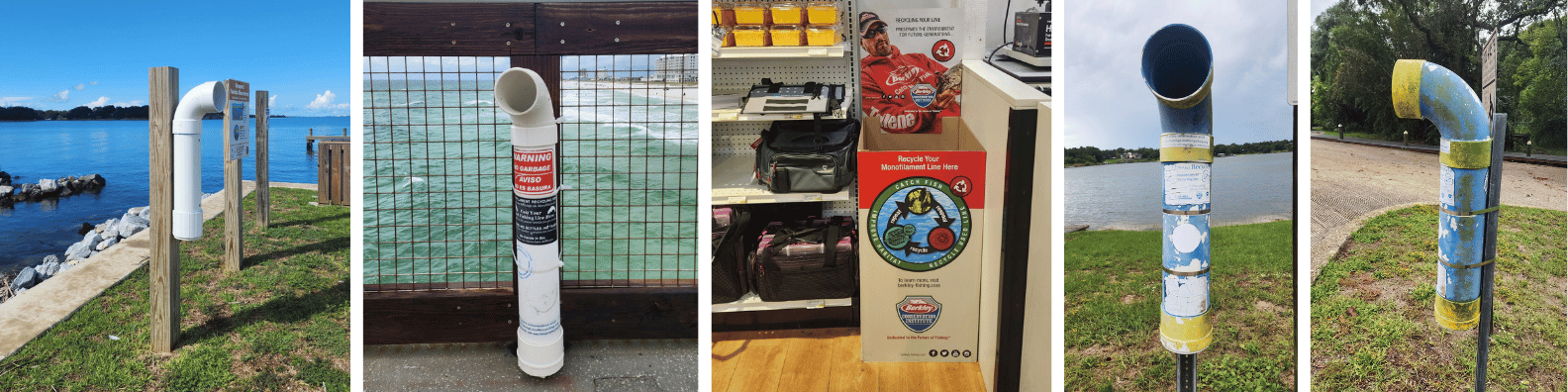
The five located bins showed a wide range of effectiveness. Three were in good condition, with clear graphics and an appearance of regular maintenance. Two were in poor condition, with only partly legible decals, unclear instructions, and mixed fishing line and litter.
The strongest example was West Marine on Davis Highway. The indoor bin was easy to find, clean, legible, and supported by clear recycling instructions. A West Marine staff member described an active collection process: leftover line is deposited in the bin and sent to the sponsor for recycling. This location demonstrates how a bin becomes more effective when physical infrastructure, active stewardship, and staff engagement work together.
The strongest site demonstrates effective stewardship, but even the strongest existing example leaves an opportunity to turn recycling infrastructure into community engagement.
By contrast, the bins at Bayou Texar Boat Ramp and Navy Point were difficult to interpret as active conservation infrastructure. Both showed poor condition, partly legible decals, unclear instructions, mixed fishing line and litter, and no visible steward information. The bins felt more like aging warning or regulatory labels—communicating what people should not do—than inviting conservation touchpoints that make participation feel immediate, positive, and worthwhile.
This contrast highlights a central communication-design opportunity: each bin should clearly explain what belongs there, why it matters, and what happens after line is collected. Clear calls to action, refreshed graphics, and compelling wildlife- or water-focused visuals could make the experience more immediate and human. QR codes could also connect users to bin-status reporting, local cleanup events, stewardship opportunities, and information about the recycling process.
Clear Community Support
In addition to site observations, I spoke with approximately 15 people at or near surveyed locations, including marina and retail staff, anglers, and other community members. The strongest message was not indifference, but interest: fishing-line pollution was widely recognized as a local concern, and people consistently expressed a need for more visible, dependable recycling options.
Several people also showed a willingness to participate. At Swamphouse Marina, staff expressed interest in fishing-line recycling and asked to be contacted about replacing the missing unit. Others offered practical feedback on bin design, contamination, and maintenance.
One fisherman said he avoided bins that appeared neglected or contained trash because he was unsure the line would be collected and concerned it could ultimately find its way back into the water.
This feedback is encouraging and indicates that the people from the community not only want a strong fishing-line recycling program, but some are are willing to provide input to improve one and help sustain it.
Opportunities for Improvement
While this 15-site assessment is not an exhaustive review of the program or its statewide needs, it identifies practical areas for improvement—many of which can build on tools and approaches that were less accessible when the program was first introduced. A broader, formal assessment could help prioritize these opportunities in alignment with current program goals. In the meantime, the following directions offer practical starting points:
Reconsider the bin design. Review bin design, placement, cost, durability, and ease of servicing.
Use clear, high-impact communication. Pair simple instructions with compelling visuals and messaging that builds empathy and invites action.
Connect bins to action. Add QR codes that allow people to report issues, find cleanup events, adopt a bin, and learn more about why recycling fishing line matters.
Build a visible maintenance system. Establish regular site checks, supported by a simple mechanism for sponsors to report bin status. A shared tracking system could document completed reviews, flag missed checks, notify the appropriate sponsor when attention is needed, and show which sites are actively maintained or require follow-up.
Make progress visible. A public-facing dashboard or verified location map could show active locations, maintenance status, reported issues, and opportunities for local involvement—building trust through transparency.
Strengthen the local network. Invite feedback from anglers, cleanup volunteers, nearby businesses, local officials, and existing sponsors, then use that input to inform system improvements.
Support long-term viability. Assess maintenance needs and funding sources, including local business or corporate sponsorships, while connecting the program to broader regional and national marine-debris efforts.
A Strong Foundation to Build Upon
Florida has already invested in a meaningful model: a recognized statewide program, a clear purpose, and physical infrastructure. These findings should not be read as a reason to abandon that model, but as an opportunity to reassess and reactivate it with a fresh, forward-looking strategy.
A renewed approach could make the network more responsive, community-connected, and easier to trust—one that is easier to find, easier to participate in, and easier for communities to help sustain.